ODOO FOR WHOLESALE AND DISTRIBUTION
Odoo for wholesale, from customer order to shipment
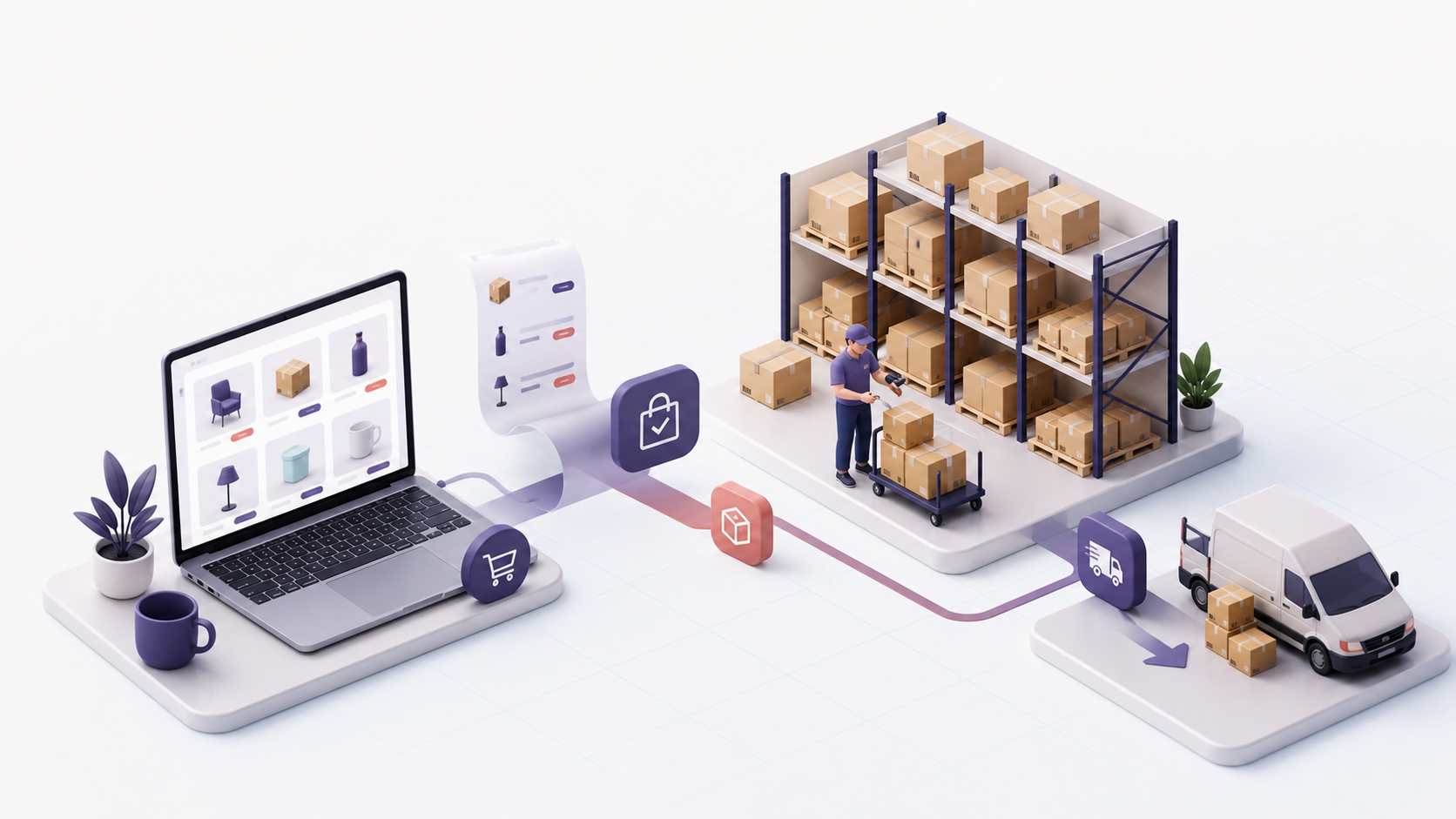
Odoo for wholesale makes sense when orders, customer pricing, stock and shipping are managed through email, spreadsheets and disconnected applications. The first goal is not to introduce every available feature. It is to connect the flow from customer order to delivery so that the same data is not entered repeatedly by different departments.
Standard-first
Phased implementation
Real business data
For a company that mostly sells known products to existing customers, a focused first phase can organise sales, purchasing, inventory and the data required for invoicing. A B2B portal, barcode operations and integrations can follow once the core process works with real data.
Does this look familiar?
Wholesale operations rarely fail because the team cannot produce a quotation. The problem begins when sales receives an order by email, checks the price and stock manually, then passes the lines to the warehouse while accounting later tries to determine what was actually delivered.
Typical signs include:
- every customer has a price list, but it is not always clear which version is current;
- sales must call the warehouse before confirming a delivery date;
- orders are copied from email or spreadsheets into another application;
- partial deliveries, returns and replacements remain in someone's notes;
- management lacks one view of ordered, available, delivered and invoiced quantities;
- key employees know the process from memory, but the rest of the team cannot see it.
An ERP cannot repair unclear rules on its own. It can provide one source of data and a clear document flow when the company first agrees who controls prices, who confirms orders and when the warehouse may prepare goods.
A connected process, not another isolated application
The order should continue through sales, inventory, shipping and invoicing without repeated manual entry.
Focused first phase
What do we solve in the first phase?
The first phase is deliberately limited. It covers the process most wholesale companies repeat every day.
Sales
Customers, contacts, products, quotations, sales orders and price lists by customer or customer group. If quotations, discounts and approvals need attention first, see Odoo Sales.
Purchasing
Suppliers, purchasing terms, purchase orders and expected receipts. The warehouse should not need to guess when goods will arrive or which order they belong to. More information is available on the Odoo Purchasing page.
Inventory and shipping
Receipts, available quantities, delivery preparation, partial deliveries and shipping documents. The essential point is that warehouse employees receive clear instructions about what to prepare and for which customer.
Invoicing flow
The sales order and recorded delivery should provide reliable data for invoicing according to the agreed rule. The exact workflow depends on accounting, tax settings and local requirements, so it must be verified for the specific company.
During the first phase, we test several real orders, including at least one normal case and one exception. This exposes unclear price lists, incorrect product codes, inconsistent units of measure and unusual shipping cases before a wider rollout.
Optional second phase
What can wait for the second phase?
Trying to solve everything on the first day is an expensive mistake. The second phase exists so that extensions are introduced after the basic data and working method are stable.
B2B portal
A business customer can sign in, view the relevant catalogue and terms, and submit a repeat order. This is useful, but it does not need to be a prerequisite for organising internal sales and inventory. The Odoo B2B portal page explains what should be prepared before opening a portal to customers.
Barcodes, multiple warehouses and advanced replenishment
These features make sense when the warehouse already records incoming and outgoing goods reliably. Otherwise, they only record the existing error more quickly.
Integrations
EDI, carriers, an external webshop, supplier systems and special labels are assessed separately. Data ownership, error handling, available connectors and the hosting model need to be checked before promising a ready-made connection.
What does the process analysis include?
Before a large ERP project, we first follow one real order. A long specification is not required. It is more useful to see how the order actually enters the company, who checks the price and stock, when the warehouse receives its task and how the data becomes an invoice.
The analysis provides four practical outputs:
1. a map of the current flow from order to delivery;
2. a list of data that must be cleaned before migration, such as customers, products and price lists;
3. a proposal for a focused first phase with clearly stated open questions;
4. a list of items that should remain for later development.
This avoids adapting Odoo to every existing habit. The first step is to determine which activities create control and which exist only because employees work in disconnected tools. The broader approach to planning, migration and training is explained on the Odoo implementation in Croatia page.
What you receive from the analysis
Current flow
Data readiness
First phase
Open questions
When is Odoo not the first step?
Odoo is not automatically the right choice for every wholesaler. If one person manages a small number of simple orders, inventory is uncomplicated and the current application produces reliable invoices, a new ERP implementation may not yet be justified.
It is also not a good first move when nobody can decide which price list is current, which product codes are valid or who may approve an exception. Responsibilities and master data should be organised first. The system can help enforce rules, but it cannot invent them for the company.
What should you prepare for the first conversation?
A useful initial assessment requires only a few real examples:
- one regular customer order;
- one order with a changed quantity, price or delivery date;
- the current price list or the rule used to calculate the price;
- an example of goods received and shipped;
- a list of applications and external partners that must exchange data;
- a person who can confirm how the process actually works.
If you are considering Odoo for wholesale, send an example order, price list or shipping flow. In a short conversation we can identify what standard Odoo can cover, what needs further verification and where Odoo is probably not the right first step.
Start with one real customer order
A real order and price list reveal more than a long generic specification.
Arrange a process analysis